


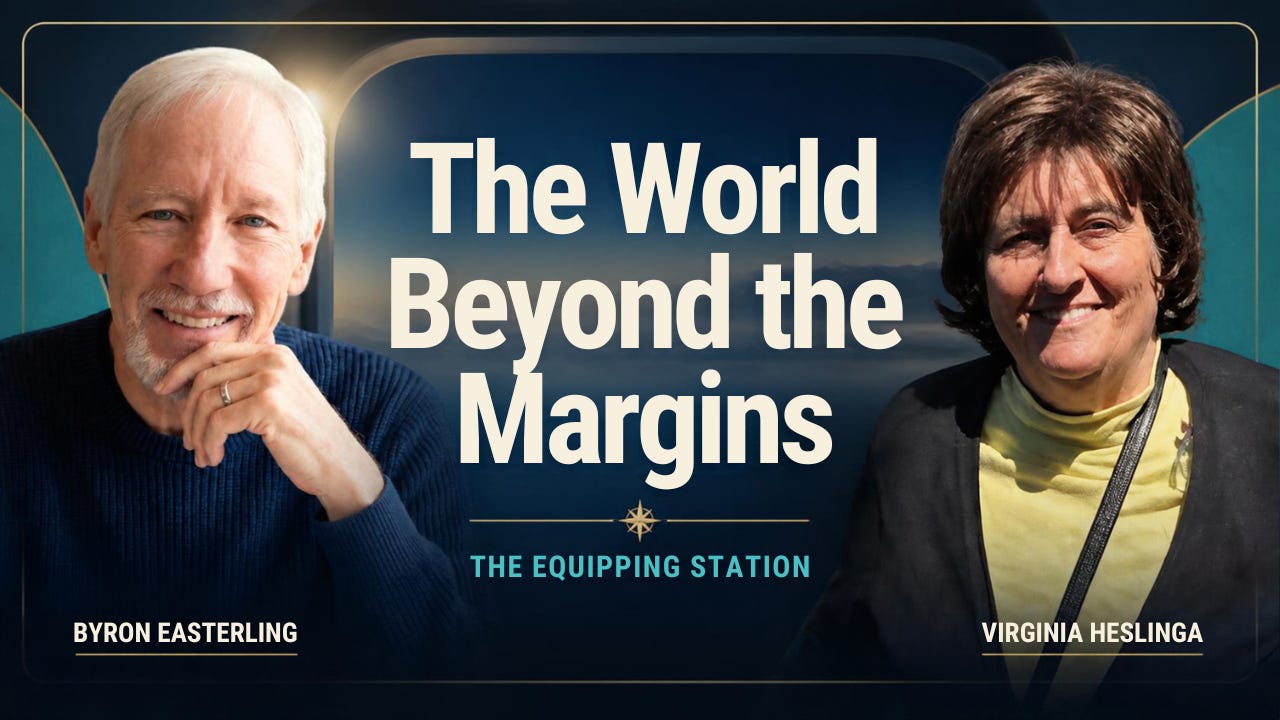
Welcome to another conversation where we step away from the noise to focus on genuine storytelling and authentic connection.
Today, I have the privilege of speaking with Virginia Heslinga, a writer whose worldview has been profoundly shaped by life far beyond the margins of a typical writing desk. From teaching in remote corners of China to navigating deep personal resilience in her memoirs and historical fiction—including Grace Interlaced and Wounded Dove—Virginia brings a rare, hard-earned depth to her work.
She is also a creator who deliberately pushes back against the tide of modern digital media. In an era where so many are driven by algorithmic approval, unfair gatekeepers, and the constant push for monetization, Virginia has purposefully carved out a quiet, sunlit space on Substack.
She writes not to build an empire, but to prioritize what actually matters: cross-cultural empathy, thoughtful reflection, and the simple joy of sharing life alongside others.
Let’s dive right into her journey.
Byron: Take us back to the moment you decided to start this publication. What specific conviction or quiet nudge made you finally say, "I need to write about this"?
Virginia: Since I love reading stories and reflections on life, as I moved more into part-time teaching, I looked for a group to join that would offer me a spot to be a reader and contributor of stories and reflections. During COVID, I noted and read many posts on Medium. I posted there, but over time learned about Substack and saw some differences in approaches and expectations. I appreciated that Substack bypassed traditional ad-driven and algorithm-dominated media, so I switched from Medium to Substack in November 2024.
The nudge to move to Substack included still wanting a place to learn and enjoy the writing of others while disciplining myself to post at least once a month. I maintain a goal better when it involves a set period of time and sharing with others. Substack also gives writers their own subscriber email lists that can be exported and allows for contact with followers. I also like that Substack posts go to the subscriber’s inbox. Medium had too many shifts in algorithms, like unfair gatekeepers. Substack seemed more open to meet needs of writers and subscribers.
It seems like I am one of few who do not seek paying subscribers, and I know that this is changing too. Substack wants writers to have subscribers in their strict paid-tier minimums. However with posts and notes people can still discover new writers. I check out the writers recommended by people I read regularly and expect to stay on Substack to share broadly until it absolutely requires all participants to be or have paying subscribers.
Byron: Every writer has a different ecosystem for their creative genius. What does your actual writing environment look like?
Virginia: My writing environment used to be a dining room. It has 3 big windows, so I have views of the outdoors and usually lots of sunlight. We have a kitchen table and chairs and a back porch table and chairs, so I took over the dining room to be an office, library, sitting and exercise room. It’s crowded with books, memorabilia, technology tools, a couple of chairs and small sofa, but the space, daytime light, nighttime quiet make this space one I am glad to enter and stay in for hours. Because my days are full of many different activities, I am glad to go into my work environment any time I have time to write.
Byron: What quiet hobby, habit, or passion do you have outside of writing that surprisingly influences how you view the world and construct your sentences?
Virginia: Living and teaching in other countries, especially in remote areas where most tourists do not visit has taught me a lot and changed my daily and long-term outlooks on needs, events, and people. Communication and everyday encounters with cultural differences bring insight and value to a person’s own culture.
I think the change in views on needs started as anyone can see in my first memoir, Grace Interlaced, when a nighttime fire took everything but the clothes on our backs, including my youngest brother’s life.
In writing a historical novel, all true but with some names and timeline changes, Wounded Dove, the main character, a Danish immigrant in Worcester, MA contracted polio at an early age and had to overcome negativity and prejudice from family members, schoolmates, and employers. When she thought she found love, a shocking betrayal occurred. Learning about people who cope with daily difficulties does change a person’s outlook.
My latest project, a five-book series based on my non-consecutive years of teaching in China, 2004 through 2017, changed my life from personal relationships to faith to appreciating differences.
The first year I was a team member and did not know much about the other people on my team until we were in China. The following years I was a team leader so had the experience of preparing for the work and in teambuilding before we left the USA.
China under Hu Jintao (2003-2013) was very different than it is under the current president, Xi Jinping, but people from the most remote areas to the largest cities share a desire to learn, hospitality, hopes and goals.
Byron: If a new reader landed on your page today and only had time to read one piece from your archive to truly understand your heart and your message, which post would you point them to and why?
Virginia: If a new reader landed on my Substack page today and could just read one piece to understand my heart and message, I’d point them to “Very superstitious writings on the wall.”
This was published March 13, 2026. Here are the first few sentences. “I’ve enjoyed Stevie Wonder songs since the 70s. Even when I didn’t agree with all the lyrics, they’d stick in my mind with his tunes. Superstitions are like that, too, aren’t they? In his song, Superstitions, Stevie also wrote, “When you believe in things that you don’t understand, then you suffer.”
Virginia, thank you so much for taking the time to share your heart and your story with us today. Your journey—from that sunlit, book-filled dining room to the remote classrooms of China—is a powerful reminder of how much our worldview expands when we intentionally step outside our comfort zones and engage with different cultures.
In a digital landscape that constantly pressures creators to monetize, optimize, and build massive platforms, your quiet commitment to genuine, relational storytelling is exactly the kind of refreshing authenticity we need more of. You are a testament to the fact that writing doesn’t have to be an industry; it can simply be a shared space for empathy and connection.
For everyone reading, I highly encourage you to seek out Virginia’s work on Substack and experience her unique perspective for yourself. A perfect place to start is her piece, “Very superstitious writings on the wall.”
Virginia, thank you again for your wisdom, your resilience, and for simply walking alongside us today.
If you would like to be highlighted on The Equipping Station, send me a message here on Substack, and we’ll connect.
I appreciate how Byron's questions focus on finding the soul sources and environmental aspects of what a person chooses to write. Thanks, Byron.