


[5 Minute Read]
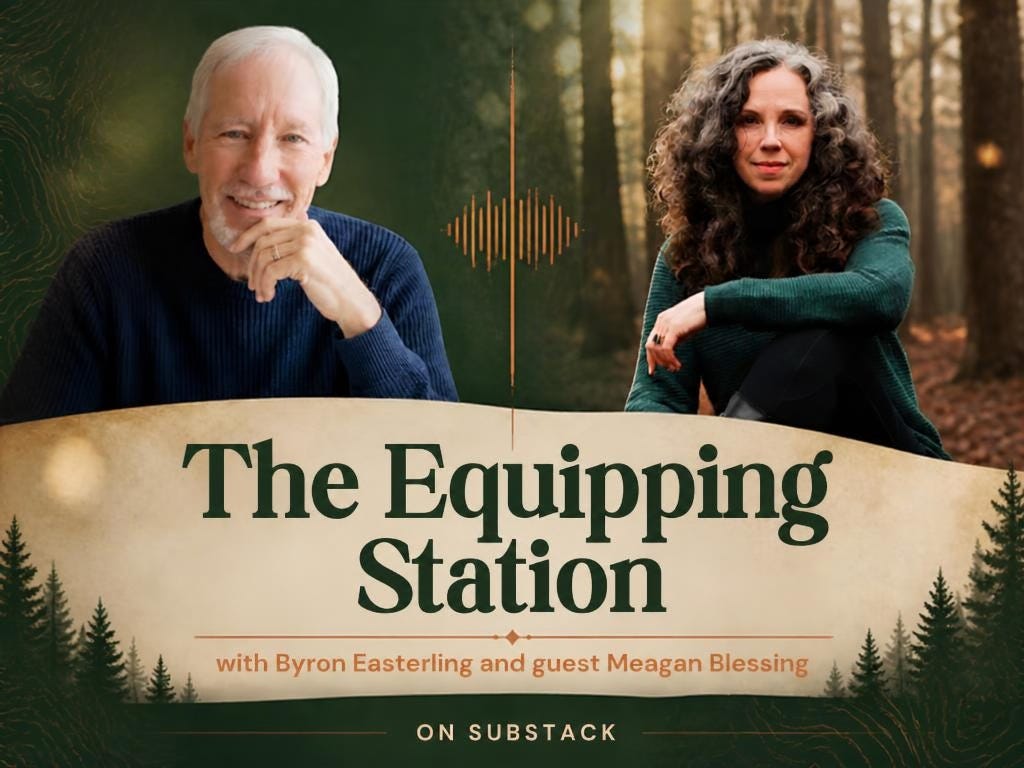
Welcome to The Equipping Station. Today, I’m really looking forward to talking with someone whose journey I’ve been following for quite a while. My guest is Meagan, the creative voice behind the Substack Imagination Ink and author of Going To Extremes: Trusting God with the Adventure of Your Life.
Meagan’s story is anything but ordinary. It’s one of bold leaps of faith, profound spiritual encounters, and a massive cross-country move that included a memorable chapter up in Alaska.
What I appreciate most about Meagan is her dedication to keeping wonder alive. She uses her writing to help us quiet our overly rational minds so we can actually notice the divine opportunities right in front of us.
Today, we’re talking about her creative rhythms, what it takes to step out into the unknown, and how she builds genuine community. It’s a great conversation, so let’s get right into it.
Byron: Welcome, Meagan. Thanks for taking the time and making the effort to join me today. We’ve known each other for a while now. I’ve followed your journey to and from Alaska and the genuine pathway you’ve expressed in life. I’m looking forward to discovering more today. With that, take us back to the moment you decided to start this publication. What specific conviction or quiet nudge made you finally say, “I need to do this”?
Meagan: Imagination Ink was born out of a desire to notice and appreciate wonder (steeped as we all are in the mindsets formed by our current age of reason), so that we do not miss the divine opportunities God offers to all of us.
I’ve had supernatural dreams and experiences from the time I was a young child. Prior to COVID, these occurrences became so numerous and persistent that I could not write them off as coincidental or unimportant. Over the next several years, my dreams (and my husband’s visions) led us on a divine adventure that drastically changed the course of our lives for the better, moving us and our business thousands of miles across the country.
In an effort to document our experience, I wrote a book from the journals I kept during that time. Going To Extremes: Trusting God with the Adventure of Your Life was published in October of 2023. In the fall of 2025, the audiobook was published. All versions are available on Amazon.
While Going To Extremes documents the spiritual dreams and visions that informed our decisions and actions in the natural, some of my experiences are so far out of the realm of “normal,” that I felt I could better articulate them in the genre of fiction through Imagination Ink.
This also gives me license to create a story that is believable in the sense that it could be fantasy (at the time of this writing, everything I’ve written about actually happened). In this way, our spirits are free to connect with another realm they understand without our rational minds getting in the way and shutting down the wonder that makes life delightful.
Imagination Ink is the place where I can write without inhibition and encourage readers to notice their own encounters with wonder.
Byron: When you are staring at a blank screen, and the words aren't coming naturally, what is the core 'why' that keeps you in the chair?
Meagan: When I stare at a blank screen, the thing that keeps me in my chair is the simple discipline of the time allotment I’ve set for writing that day. The reverse is also true: if I do not create a calendar entry slot for writing and set my timer, it won’t happen.
I wrote my book in less than 6 months by creating an outline and writing. I had an idea of what I wanted to say, but no clue of how to make it interesting to readers. In the end, I would simply free-write without any regard for grammar, typos, or sentence structure.
The goal was to get whatever was in my head into print. I pray before I write or paint, and I can attest to the fact that any creative act is a collaborative effort with the Holy Spirit. I had a daily word count and would usually surpass that, knowing the editing would greatly reduce the number of superfluous words. After a week or so, I would go back to my free writes and begin to shape them. Once I had the raw material to work with, the process of refinement became much easier.
An encouragement for writers: forget about perfection. There is no such thing. What you are doing is breathing an idea into life, then adding just enough detail to make it understandable while still leaving enough to the imagination of the reader that the idea you released can reside in their imagination, taking on a life of its own for them.
Byron: Substack is unique because it's less about shouting at the masses and more about building a deep, relational neighborhood. How do you intentionally cultivate connection with your readers rather than just trying to build a massive platform?
Meagan: I don’t think Substack is very different from other online communities. It does seem to be more curated when it comes to the algorithm, but honestly, the way to meet people and become part of any community, Substack included, is to be friendly. You’ll remember the old saying, “You need to be a friend to make a friend."
When I am on the app, I endeavor to comment intelligently on other people’s notes and long-form writings, restacking bits I think my readership might find interesting.
I also look for beauty, and will share things that bring me delight for no other reason than for my own happiness and the assumption that if I enjoy it, others may feel the same.
The imperfect, intuitive nature of how I approach this process is what makes me human. I’m not looking for a specific outcome. I’m just sharing ideas, knowing that those who need to read them will find them. I feel there is a spirit of Renaissance behind the whole thing.
Byron: Every writer has a different ecosystem for their creative genius. What does your actual writing environment look like? (Is there a specific setting, a daily walk, or a certain rhythm that gets you into your flow?)
Meagan: My writing ecosystem is, for the most part, orderly and pleasant. I have been blessed with a turn-key study with a built-in corner desk with bookshelves, and a window that looks out onto a little private deck that I never sit on. I’ve seen deer, foxes, and hawks in the forest beyond the deck as I write. It is a cozy place.
I don’t thrive in a disorderly environment, but I do have all my favorite things neatly placed on my desk: a diffuser with seasonal essential oils, my antique dip, quill, and fountain pens, jadeite ink blotter, and my commonplace book. A plant that a friend in Alaska gifted me perches on the windowsill, blooming cheerfully with a profusion of buttery golden flowers each spring. My guitar and mandolin hang on the wall behind me, within easy reach above my prayer chair. A whale baleen painted with the blessing from Numbers 6 (bestowed upon me by a native friend in Utqiagvik), and a few of my paintings grace the walls.
My study is a haven, really. I enjoy being there, and have curated the atmosphere to be one that is conducive to relaxation, creativity, and wonder. This makes it a pleasant, and therefore, optimal, place for me to write.
Every writer is different. I have a dear friend on Substack who writes in an austere environment, with a ladder-backed wooden chair and a tiny antique desk. Another friend’s office is so stuffed with stuff that I couldn’t concentrate in there, but she types happily away, surrounded by her piles of papers.
The important thing is to figure out what type of environment allows your body to settle and your mind to quiet, so you can enter a flow state while writing. In this place, you will consistently create your best work.
Byron: If a new reader landed on your page today and only had time to read one piece from your archive to truly understand your heart and your message, which post would you point them to and why?
Meagan: A good introduction to my writing is my Substack long-form post, Point of No Return. This post invites the reader to step into a mystery they cannot master; to weigh the benefits of the comfortable familiar against the uncomfortable unknown. Most people never take this step, preferring to stay on the familiar path. However, stepping across the threshold of whatever decision they are facing with confidence is where wonder waits. As people of faith, I am convinced that stepping into a mystery we cannot master is, at some point, unavoidable. What do you think?
Point of No Return
Byron: That wraps up my conversation with Meagan today. I really appreciate you taking the time to share such an honest look into your creative haven and journey of stepping into the unknown.
If her perspective on trusting God and noticing wonder resonated with you, I highly encourage you to stop by her publication, Imagination Ink, and see if there’s a connect. Read her featured piece, “Point of No Return,” and drop a comment to introduce yourself.
Because as we all know, Substack is all about the connect—building a genuine, relational neighborhood rather than just shouting at the masses. Thanks for spending a few minutes with us here at The Equipping Station, and I’ll catch you next time.