


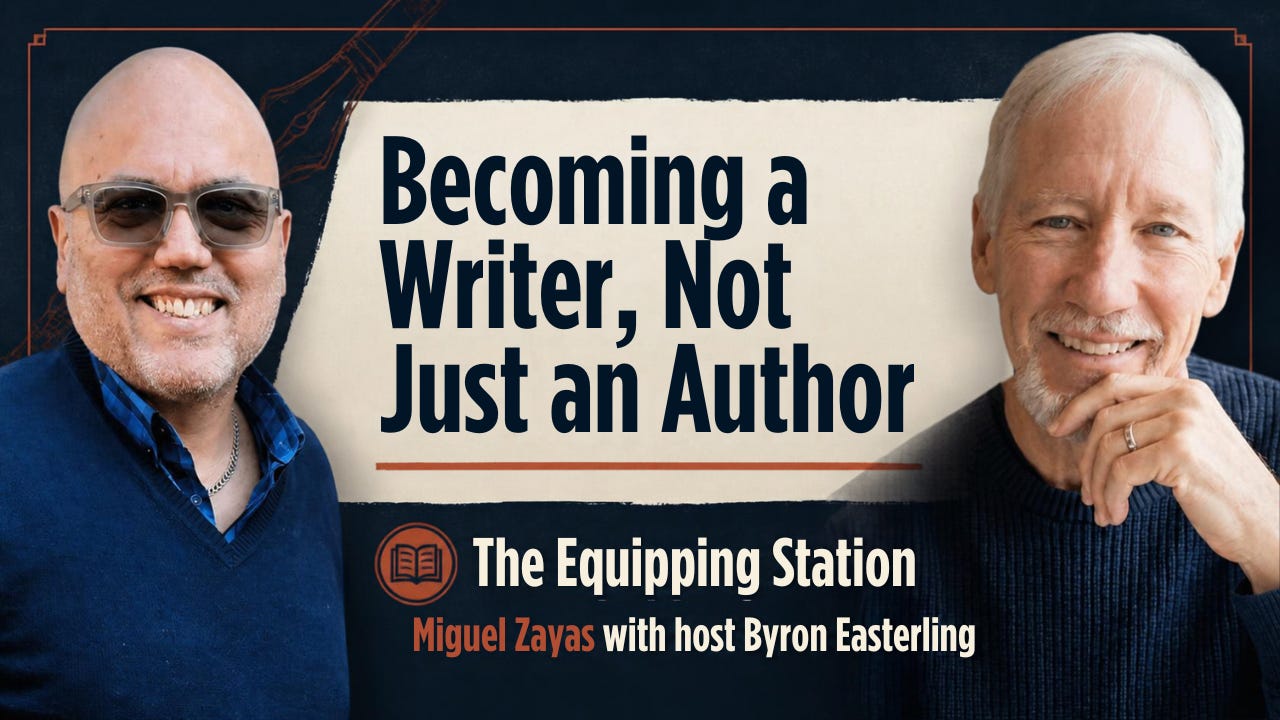
One of the best ways to grow is to listen to the people who are out there doing the work, which is why I’m thrilled to introduce a new interview series to The Equipping Station.
I’m sitting down with fellow Substackers to get behind the scenes of their creative process and discover how they are investing in their readers. This isn't about chasing algorithms; it’s about sharing the wisdom, the struggles, and the quiet victories of authentic communication.
I’m starting these conversations because I believe we equip each other best when we share our stories honestly. Today, I’m excited to welcome Miguel Zayas to share what he is cultivating in his own corner of the internet.
Discover how navigating profound endings and preaching what might have been his final sermon taught Miguel to stop chasing a platform and start building a deeply authentic neighborhood from inside life's unanswered questions.
Byron: Welcome, Miguel. Thanks for taking the time to be on The Equipping Station. Would you take us back to the moment you decided to start this publication? What specific conviction or quiet nudge made you finally say, “I need to write about this”?
Miguel: I had already been working on a manuscript about endings and transitions, and as I began trying to find an agent, one of the things I heard, in essence, was that I was not really a known figure. That was fair. I had spent most of my life leading, pastoring, speaking, and working with people, but I had not spent much time building a public writing voice or audience.
That became part of the reason I started the Substack. I wanted to become a better writer, but I also wanted to begin introducing some of the ideas behind the manuscript in ways that were connected to the book without simply repeating it. The book has its own structure and purpose, while Substack gives me room to explore some of the same themes through personal stories, leadership experiences, questions I am still working through, and things I am noticing in real time.
I think the real shift came when I stopped thinking only about getting a book published and started thinking more about becoming a writer. I needed a place to practice, find my voice, and see whether some of the things I have lived through and wrestled with might connect with other people too.
Byron: Substack is unique because it’s less about shouting at the masses and more about building a deep, relational neighborhood. How do you intentionally cultivate connection with your readers rather than just trying to build a massive platform?
Miguel: I am still learning this, so I do not want to make it sound like I have some big strategy figured out. What I do know is that I do not want to write at people. Most of what I write begins with something I have actually lived, a church closing, sitting in a hospital room and not knowing what to say, a leadership mistake, a conversation with a friend, or a moment that catches me off guard and makes me stop and think.
From there, I try to ask what might be in that experience that someone else recognizes in their own life. I think what I want most is for someone to read something and think, I have felt that too. I just did not know how to put words around it. That is probably why I resist wrapping everything up too neatly. Life is not that neat, and faith is not always that neat either. Sometimes there is an answer, and sometimes there is simply a question you learn to live with for a while.
For me, connection happens when people feel like they are part of the reflection, not just receiving my conclusions. I want the writing to feel more like sitting across the table from someone and talking honestly than standing in front of a room giving a talk.
Byron: If a new reader landed on your page today and only had time to read one piece from your archive to truly understand your heart and your message, which post would you point them to and why?
Miguel: I would probably send them to “What If That Was My Last Sermon?” In December 2022, I preached the final sermon at a church I had pastored for five and a half years. I knew the church was closing, but what I did not know was whether I might also be preaching my last sermon as the pastor of a local church.
It has been almost four years, and I still do not know. I am still in Christian ministry, and I get to speak, teach, travel, and serve people in ways I genuinely enjoy. At the same time, there is something about the rhythm of local church life and people calling you their pastor that is hard to explain if you have lived in it for a long time.
That article probably sounds most like what I am trying to do with my writing because I am not writing from a place where everything has been resolved. I am writing from inside some of the questions, and I think that is where a lot of us actually live. We know some things, we trust some things, and there are still parts of our story that remain unfinished.

Byron: When you look at the landscape of independent writing right now, what encourages you the most about the era we are stepping into as creators?
Miguel: I like that we can simply write and find out if people want to read it. For a long time it felt like there were so many gates between having something to say and finding people who might want to hear it. You needed a publisher, a platform, a large following, or someone to decide your voice was worth putting in front of people. Some of those things still matter, but they are no longer the only way to begin.
I also like that there seems to be room again for longer thoughts. So much of what we consume now is quick: a clip, a headline, a reaction, a few seconds of someone talking before we move on to the next thing. I think a lot of us are tired of that and are looking for places where we can sit with an idea for a few minutes, think about it, and maybe even return to it later.
I really do not know where all of this leads for me. I have a book I hope to publish, and I would love for writing to open doors for conversations around leadership, faith, endings, curiosity, and some of the things I have spent years living through. For now, I am enjoying becoming a better writer, learning my own voice, and discovering that there are people who want to think about some of these things with me. That feels like enough reason to keep going.
Byron: Thanks again, Miguel, for taking the time to dig deeper and go further with your writing and expressing your heartbeat for the Father.
Miguel’s journey is a beautiful reminder that we don’t need to have everything neatly wrapped up to step out and share our stories. Sometimes, just being honest about the questions is exactly what someone else needs to hear.
I'd love to hear from you in the comments: what is one transition or unanswered question you are learning to live with right now?
Stop by Miguel’s Substack page and discover more of his writing, stories, and heart!
If you would like to be highlighted on The Equipping Station, send me a message here on Substack, and we’ll connect.
The Art of Walking Alongside: A Discipleship Guide for the New Era. Formulas don’t change lives. Relationships do.
Truth and power appear in the interview with Zayas. "I am not writing from a place where everything has been resolved. I am writing from inside some of the questions, and I think that is where a lot of us actually live. We know some things, we trust some things, and there are still parts of our story that remain unfinished." Thank you for highlighting this point of where so many people live in thoughts, feelings, relationships, and writing.